Here's where you come to follow the progress of your piece of furniture in the shop. No, wood doesn't talk--or does it? Sure it does! As we work on your piece we learn things about where it's been, how it's been used, maybe even who (or what) has used it, and often about where it came from originally. It's a lot of fun and typically quite interesting.

This space also gives us a chance to let you know about any special experiences or progress related challenges. We try to chronicle work completed on your furniture whenever anything significant occurs. So there may not be an entry every day, but when we document them, we hope you will find these journal entries are fun, informative, purposeful, and creative.

So, have fun "listening" to our dialogue with your piece, as it is, it's Wood Talkin.
Email: woodtalkin@gmail.com

Thursday, December 13, 2012

A whole body "face-lift" at 72

I got a call to look at a family heirloom. My customer explained how she had recently inherited it from her mom, and as she described it, "a gold colored curio cabinet." Whenever I hear the words "gold colored" or "painted gold" attributed to an early 1900's piece my ears come to "A-tten-tion!". 

There was a lot of  really fine "gold-leafed" furniture manufactured in the 19th and early 20th centuries. Lots of it repeated or incorporated classic styles of the 16 and 17th. centuries. So, understandably, I wondered if the piece she was describing might fall in that category. I asked her to text me (above) a picture. 

Sure enough. What I saw justified the scheduled visit to her home and some timely discussion about what she wanted to do with her mom's "gold colored curio cabinet." Subsequently, I did some investigation about the manufacture, the Weiman Furniture Company, and their Table Quality Eirloom Series in the 1930-1940's.

I was fascinated to find exactly the same piece, an heirloom French Vitrine, featured in a fine furniture store, in N.Y., NY....and it wasn't going to sell for pennies on the dollar! This was the real deal. I suggested three choices: don't do anything, but maybe touch it up a little; sell it and buy an attractive piece that will fit your color scheme; or, refinish it. Understandably, my customer has chosen to keep this marvelous little vitrine "in the family." This little 72 year-old jewel will get what we'll call a "full-body face lift." Yah...don't you wish!

That's Wood Talkin for today. You might want to follow this fun little story...so keep listening.

Saturday, December 1, 2012

Here's another, "Is it or isn't it."

Ummm um. A handsome sight!
It's a 1930-40 vintage medium "Hope Chest," otherwise described as a Cedar Chest. The question I'm wanting to answer here is the one many ask, "Is it a Lane?" In this particular instance I really don't know. The obvious serial/model number on its marvelous backside doesn't look "Lane." But that may have more to do with my ignorance than it has anything to do with the chest's historic identity. 

What you see in the (top) picture is the almost completed refinish/"restoration." Compare it to what it looked like when it came into the shop (below). As you can see it  had a lot of battle scars, not the least of which--and the most visually grabbing--was a very large water spot on the center, front edge of the lid. The Walnut veneer was badly checked and split in that spot and it was also deeply discolored. Bummer!


With that kind of insult and its accompanying discoloration in the veneer, any anticipation of it's complete removal is generally poor. But that doesn't mean we can't hope and try...right?! So we did, and I think we realized a marvelous return on our "hope investment." (What do you think?) So, understandably, this handsome guy is begging to go home. When that finally does happen a lot of it's furniture compadres will do a jaw drop as they see this handsome guy reappear. 

Monday, one more top coat and some generous hand buffing will find it ready for a timely home delivery. 

That's Wood Talkin for today. Keep listening.


Wednesday, November 7, 2012

Yup, it's a 1940's vintage Cherry Duncan Pfyfe Pedestal Table. It was made by Drexel. With six accompanying chairs to compliment it, it offers a very attractive dining room presence. (As you see it here, it's just been stained with its three leafs.)
Note differences in color, top vs leafs!


Of course we often learn some fun things in the refinishing process. In this case the bases (below) are stamped "MAH" atop their pedestal bases, suggesting the table may originally have been issued with a Red Mahogany stain. You can see from the picture (right) that the three stripped leafs seem to contrast the table's top--a competition between cherry and red mahogany? God knows.

Naughty Kitty Cats!
Our goal is to blend them to the customer's preference as best we can...............CHERRY.  And whenever you've got an item as pretty as this with several years (72!) of family history behind it, we can expect to get the stories that come with that history. In this case one of those includes the presence of Kitty Cats....as you can see. If the top was of solid wood those signatures could be sanded out, but because this is a fine veneer, these kitties have permanently left their mark. Yes, those guys will be forever remembered.

The pedestals stood in line, the last to be cleaned up....so they are last but not less important.  Here, (below) you see them with clamps variously placed. Those will soon be removed and the staining process will be completed before sealing and finishing begins for all the pieces. That event is just around the corner...it'll probably be all done by the end of the week.

Yup, the table is anticipating....going home soon...An-Tic-I-Pate-Ing. Its a fun word and one I hear thematically in this shop. 
The table's two Pfyfe pedestals await stain
And that's Wood Talkin  for today....so...Keep listening.

Monday, October 22, 2012

A Prized Air-Loom

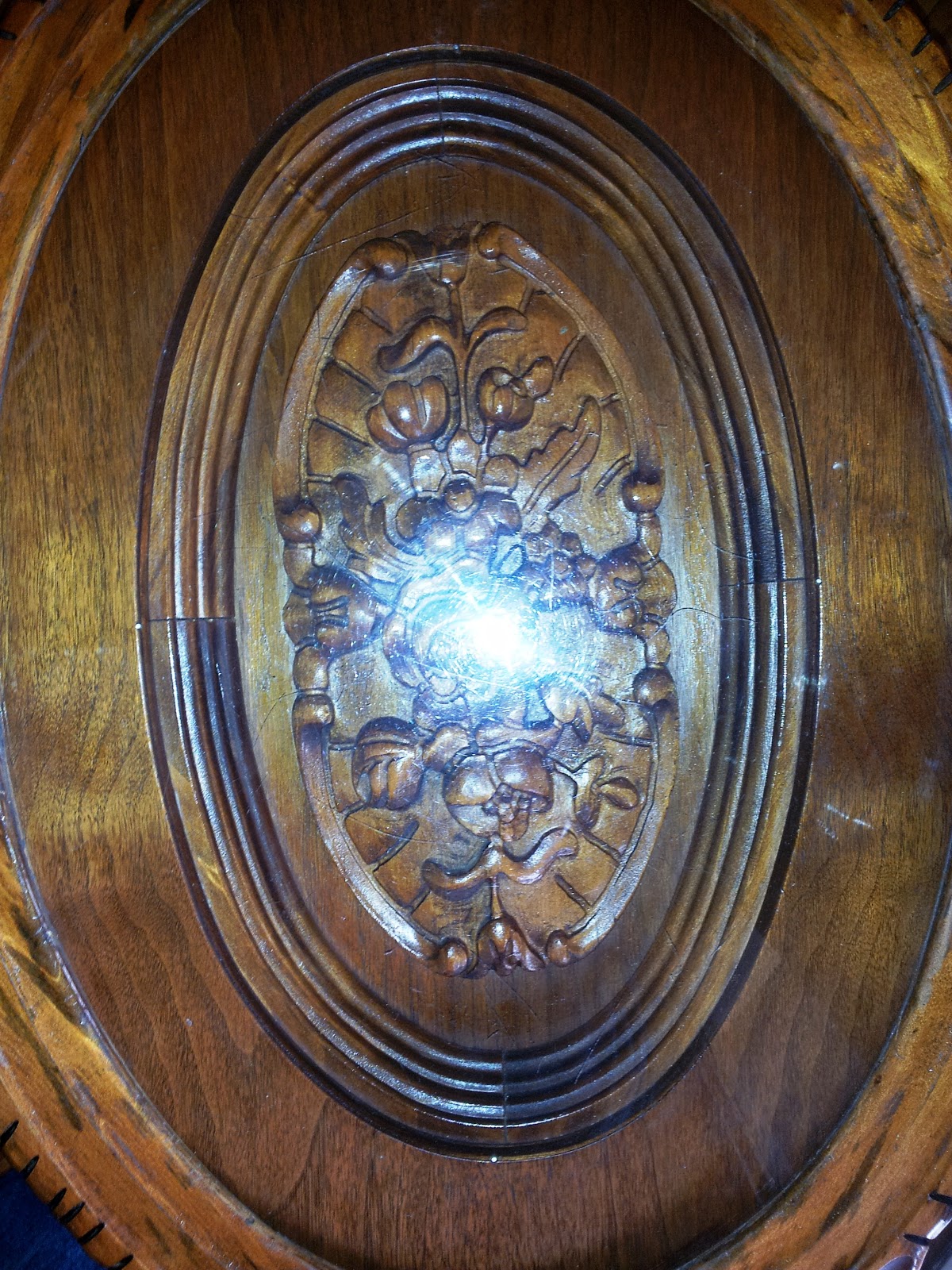
My customers reported how she has carried this little beauty with her as a coed ...and then even as an airline passenger! I think that's showing a lot more than a little affection for this piece of art--and it's just plain FUN. The piece's wonderful  walnut carving of flowers and vegetables is reliefed below the protective glass cover. Its legs and skirt are similarly carved of a softer bold grained wood, like a conifer--cedar or pine...or maybe gum.

Inspecting it very carefully I could not for sure determine if it was a 1950's replica of an Elizabethan piece or whether it was indeed Elizabethan (1830's to around 1900). Whichever, it is absolutely exquisite. Hand carved and hand made throughout, this gentle lady is a real eye grabber. At some point in the past it was re-coated with shellac. Before that....varnish or oil?

My customer has recently moved from another part of the country. In the process the legs of this little gem were severely racked and loosened. It had the motion of a rocking chair--but no longer. It stands now firmly, confidently, on those four beautiful legs. Before it went back home I gave it a treatment of (Guardsman) polish which contributed a warm, pleasant glow that is quite appropriate for any Genteel Lady.

That's Wood Talkin for today.Are you listening...cuz wood talks


Wednesday, October 17, 2012

1860's Armoire

Here's that wonderful armoire. 
As I may have mentioned before, this fascinating old gentleman introduced an interesting challenge. Initially a decision had to be made about how to address the problematic deterioration to the cabinet's exterior finish. Because it is so big it sat in an open carport for several years! Working with an antique like this I carefully discuss issues contributing to its value. For example, I want to avoid sabotaging its real value for a future appraiser or collector. If I apply 21st century refinishing materials and techniques to a mid-18th century antique--well, that would be a BIG no-no!  Similarly, I want to know what my customer's expectations really are: maybe they want a contemporary look?  This customer wanted to retain the piece's historical integrity as best we could possibly make that happen.

 Then I ran into a curious issue inside the cabinet. Close examination of the case confirmed something my customer had suggested: this old armoire was originally engineered so it would come conveniently apart. It was then fabricated so it could be disassembled in one location, taken piece-by-piece through narrow hallways or up to a second floor, and then it could be reassembled. But.....someone had more recently added the set of interior shelves you see in the picture, left. That craftsman permanently attached the shelves frame to the cabinet's front and back panels. Consequently, the armoire's cabinet was no longer able to be disassembled for easy transport.
I proposed a solution that could regain the cabinet's original design dynamic. We removed and modified the shelves and made them compatibly collapsible with the surrounding cabinet. That solution worked splendidly.

We discussed what to do with the unsalvageable exterior finish. It was completely destroyed by weather exposure--except for its crowning cornice (which stands a full seven feet above the floor, protected from rain and snow). We decided a hard oil (linseed type--no stain!) finish on this (mostly) walnut cabinet was also contemporary to the 1860's. It's use similarly simplifies cabinet care and maintenance for my customer. (Many coats of oil and hand rubbing produced what you see in the pictures.)

We took advantage of the armoire's newly regained collapse-ability. When I returned it to my customer it happily went home in pieces and was stored temporarily for future reassembly in an appropriate spot. Is that cool or what! 

That's Wood Talkin for today. Keep listening--'cuz wood talks!

Thursday, September 6, 2012

Antique Bees?

Here's a look I didn't show you....till now. I introduced the armoire, but not the beehive. Get a look at this! Yup, a hornet's nest. These bees know quality when they see it; they built their home in a corner of the high-rent district.                                                                                                                                                         My customer has told me some interesting and really fun stuff about his armoire. It's been in his family for a very l-o-n-g time. Originally it's from North Carolina--most likely the place where it was fabricated. Repeated inside the case in strategic places on its back, sides, floor and front I find the number 16--a pattern number indicating the compatability of these pieces for assembly as this particular model.  

At the time the armoire was built, homes in North Carolina were taxed according to the number of bedrooms in each home. One of the defining features of a "bedroom" was the presence of a built-in closet. So to avoid the "bedroom tax" many homes were completed with rooms on the upper floors that purposefully did not include built-in closets. Then, wise furniture makers capitalized on the demand for stand-alone closets--the armoire! Armoires like this were designed and constructed to be carried up the stairs to bedrooms.

But as you can see, this armoire is both TALL and handsome--and heavy! It stands a full 86'' from the floor to the tip of it's top cornice and it's four feet wide. Those dimensions are going to present some interesting challenges when it comes to its maneuverability--getting it up the stairs, around the tight hallway corners and through small room doors.

So it was also designed so it could be easily disassembled into seven separate pieces....its top, 2-sides, the front, the inside floor, the drawer case, and the back. Each can then be carried up the stairs separately and reassembled for service--ya just need a screwdriver. Is that cool or what!

Given the size of this handsome guy, guess how I chose to work on it in the shop. Yup, you guessed it---in pieces. After I had cleaned it up, I disassembled it and "VOILA," I'm working on each piece separately in preparation for a final reassembly...when it's all beautimus again. I'll say something about value preservation in the next blog.

So, that's Wood Talkin for this morning...and listen; your furniture speaks!

Tuesday, September 4, 2012

1860's Armoire

Tall, dark and handsome...and a whole lot dusty! This is a wonderful old walnut armoire most likely manufactured in the 1860's.  It elicits all the deep breaths appropriate of quality craftsmanship, but it was influenced by the fast approaching industrial revolution here in the United States. So, it appears to have been crafted just before that big mass-production push and just after the "official" end of what has been called "the completely hand-crafted eras."  

I'm going to tell you a lot more about it. The work will begin with a thorough cleaning and a general inspection.

That's Wood Talkin for today...are you listening?